wibiya widget

Tuesday, September 7, 2010

About those shiny flying probes ...

Speaking of big shiny flying metallic probing objects (h/t deBeauxOs) ...

Air-show flyboys rattling the rafters yesterday with their displays of testosterone-sodden militarism. Just like Gaza or Beirut, perhaps, except without the explosions and hundreds of deaths. I've always loved their sensitive and nuanced community outreach, too; yeah, we know it's louder than hell and causes permanent hearing damage, but it brings in the tourist dollars, so fuck you.

Is it unseemly to watch, on the off chance that one of the silly bastards might crash?

Noteworthy, though, is how they cancelled it the day before. Was it too cloudy? Were they afraid it might rain? Dear lord, if they can't stand up to a little rain, how will they stand up to al-Qaeda? How much did they say they're spending on the F-35 again?

Best part, though, is this little item about increased military cooperation between Russia and Israel. Heh. Does this mean Israeli jets will be providing fighter escort next time Russian bombers attempt to violate our pristine northern sovereignty? I'd pay to watch Dmitri spin that one ... 

Saturday, September 4, 2010

RCMP meltdown: Saturday morning schadenfreude


I know, I know. Taking pleasure in the misfortunes of others is so unseemly, but honestly, this couldn't happen to a nicer bunch of guys.

Linky-dinky.


Just goes to show you

The most telling paragraph from Avaaz.org's response to the attempt to spam its petition:
It's deeply disturbing that in all Avaaz's years of campaigns against US President George Bush, Burmese, Zimbabwean and Sudanese dictators, irresponsible multinational corporations and corrupt politicians, no one has ever yet stooped to this kind of tactic to undermine our members' right to express their views. 
Yep. Of all the nasties Avaaz has taken on, only Fox News North's supporters have gotten this dirty and desperate.

Update: Susan Delacourt puts the whole mess in perspective here. If she's right, then not only did Kory Teneycke know someone was adding the names of real people (Kady O'Malley, Paul Wells, Stephen Wicary, Andrew Coyne) to the Avaaz petition without their knowledge – he wrote his piece slamming Margaret Atwood citing the fact that there were fake names on the petition in order to undermine it. And this guy's going to tell us we need a right-wing Fox Noise machine because the "lamestream media" lack journalistic credibility?

Friday, September 3, 2010

And did you *check* that source, Kory?


I'm guessing not. But didn't stop him from writing a whole column based on it, now, did it.

(Update: Kady's on the trail now. Probably not the only one, either. More here, here, here, and here. Be interesting to see what comes of this ... )

Thursday, September 2, 2010

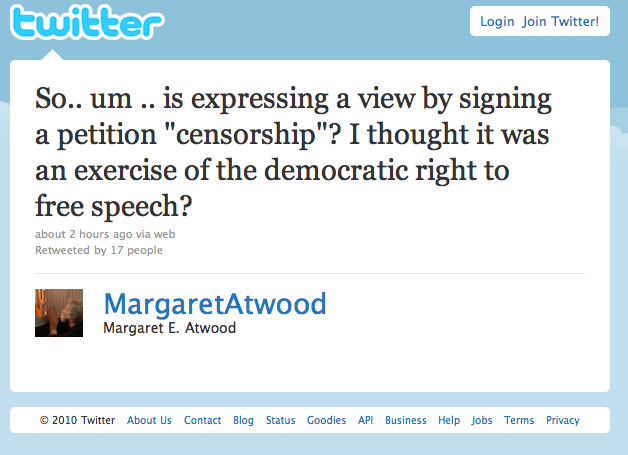
Censorship? You keep using that word ...

The online petition to keep Fox News North from infecting our national discourse is striking a nerve. Predictably, the flying monkeys of the right are whining about "censorship."


Here we go again. One of the most predictable things about the radical right is the incessant obsession with stripping words of their meanings. In their through-the-looking-glass world, words can mean anything. They can be stripped of their connotations and used with no regard for context, for history or even coherence. Case in point: among our southern friends, the disciples of Karl Rove have been so successful in turning the word "liberal" into an epithet that the entire national conversation has been hijacked. (Tip of the hat to my pal Sabina for the first link; I have a little trouble believing that the second one is genuine because the spelling and grammar are almost perfect.)

This is why it's more important than ever to ensure that terms don't get redefined. I've written previously about the need to maintain control over narratives, but it's even more fundamental to make sure that when we use terms like "freedom of speech," "civil liberties" and "censorship," we're not allowing our opponents to impose their own instrumental meanings. If we're not vigilant about that, we've lost the debate before it even begins.


So, back to first principles. Let's talk about censorship for a minute. Censorship is defined by Wikipedia as "the suppression of speech or other communication which may be considered objectionable, harmful, sensitive, or inconvenient to the general body of people as determined by a government, media outlet, or other controlling body."

With great respect to my conservative friends, nobody's arguing that Sun Media and Kory Teneycke shouldn't be allowed to set up their so-called "populist" news channel, even if the premise upon which they're basing it is contrived bullshit. What I object to is the idea of the PMO strong-arming the CRTC into making sure it gets a Category 1 licence, which would require cable carriers to include it as part of their basic TV packages. Ensuring that regulatory bodies maintain an impartial arms-length separation from the government of the day and enabling them to withstand transitory political pressure is not censorship, dear friends.

It's indicative of how debased public conversation can become, however, that principled devotion to the idea of an impartial public service can be smeared with inflammatory labels like censorship. Let's be clear: "censorship" is every bit as loaded a term as "racism." Accusations of censorship or hate speech are rhetorical and emotional cudgels which have the effect of shutting down debate. And by extension, claiming that someone else is accusing of you such things allows you to claim victim status. Either way, you've moved the debate away from issues of principle and policy and reframed it in far more volatile and easily manipulated emotional terms.

Margaret Atwood's entry into the discussion has prompted exactly this sort of response. Sun Media's Ottawa bureau chief has accused her of backing an anti-free-speech movement.


Over at Let Freedom Rain, Jymn Parrett writes about the weird entitlement thing right-wingers have when it comes to the media.  They really believe that the media have an obligation to parrot their own sense of grievance and outrage, he argues, and it drives them bonkers when that doesn't happen. As he puts it:
Sharron Angle so perfectly encapsulated this entitlement syndrome when she famously told a newsperson that she thinks the role of the media is to reflect her positions as she recites them. Palin and Dr. Laura also have publicly expressed this idea, confusing their rights with that of the first amendment.
Note to conservatives - the media is not here to read your minds and print your thoughts. You've been spoiled for too long listening to dittoheads on the radio waves and the dunderheads at Fox News. We are not all Murdoch. And that royally pisses off the right.
It seems intuitively obvious, but when you're dealing with people who view the world through a warped ideological lens, nothing is obvious. People like Sarah Palin, Michael Savage and Laura Schlessinger have been quick to claim the mantle of victimhood and cry censorship when people call them on their hatred and stupidity, but it needs to be emphasized, and repeated as often as necessary: disagreeing with someone and holding her accountable for her irresponsible and hateful rhetoric is not censorship. Freedom of speech doesn't mean you're immune from criticism. Words have consequences.

In Politics and the English Language (1946), George Orwell argued that
... one ought to recognize that the present political chaos is connected with the decay of language, and that one can probably bring about some improvement by starting at the verbal end. If you simplify your English, you are freed from the worst follies of orthodoxy. You cannot speak any of the necessary dialects, and when you make a stupid remark its stupidity will be obvious, even to yourself.
Once again, vigilance is key. If we allow them to define the words, we're letting them frame the issues and define the terms of the debate. We can't let them do that.

Tuesday, August 31, 2010

What, the goalposts aren't far enough to the right yet?


Seriously.

Between CTV and Canwest or whatever they're calling it nowadays, isn't there enough of a steady drumbeat of right-wing memes already? We don't have enough of these narratives bouncing around in the echo chamber? How much more do we need?

Ottawa police chief Vern White seems to have taken up the scaremeister-in-chief role for today, and found willing stenographers in CTV Ottawa. Terror is the new reality, apparently. Be afraid. Ottawa is vulnerable, and we don't know how many more scary brown people with funny names there are.

And so it goes. Citizens urged to be vigilant. 9/11. Let's not be lulled into a false sense of security. It's only a matter of time. Wonder how long it'll be until one of the Attack ParrotsTM trots out the old "we're fighting them over there so we don't have to fight them here" line?

Ridiculous as it is, it's also something to worry about. As the airwaves, newspapers and cyberspace fill up with these narratives – backed up by endlessly looping images of burning police cars, black-clad vandals and the like – there's going to be less room for thoughtful analysis, for nuance, for reflection, and for skepticism. Much as I'd like to think people want to devote themselves to the requirements of engaged citizenship, the sad reality is that not everyone has the time or inclination to seek out information, to think, to analyze, and to deconstruct the narratives we're being fed.

It's not especially comforting to think where it might lead. Keep people in a constant state of fear and insecurity, and sooner or later it gets easier to relieve them of their civil liberties and fundamental freedoms. Trust us, we're here to keep you safe. You don't mind all these cameras, do you? After all, if you've got nothing to hide ... Oh, and if your neighbour says something suspicious, don't hesitate to report it.

We saw this kind of thinking taking hold in the runup to the G20, and again in the aftermath. The Canadian Civil Liberties Association cites the example of a cop pushing a citizen into a van for transport to the Eastern Avenue gulag and observing "that's what you get for protesting." We've seen a lot of misguided argument similar to that, most of which goes along the lines of "well, you shouldn't have been there."

Two responses to this come to mind straight away. Firstly, the right to demonstrate, to protest and to assemble peacefully is an inherent right in an open and democratic society. No one – not the police, not the federal, provincial or municipal goverments, not private corporations – gets to take that away arbitrarily. And telling citizens who were tear-gassed, beaten, tasered or locked up that they shouldn't have been there in the first place is simply blaming the victim. When someone is sexually assaulted, do we still say "you were asking for it, you shouldn't have been there, you brought it on yourself dressing like that?"

Second, and more unsettling, is the cumulative effect that so many similar incidents have. It's not hard to discern a calculated strategy to demonize the entire idea of public protest. Keep repeating phrases like "black-clad vandals" and "riots in the streets" and showing the same images of burning police cruisers and smashed windows, and pretty soon the whole notion of protest, dissent and demonstration takes on pejorative overtones. Couple that with widespread police brutality and no effective institutional response or accountability mechanisms, and soon you have a cowed and fearful population.

It is in this context that the drive to establish a so-called "Fox News North" needs to be viewed. Not content with two major private conglomerates beating the drums, the Harper machine is moving to set up a propaganda channel of its own. What we've seen this summer, on everything from the census to the CRTC to the manufactured controversy over Homegrown, should be a pretty good indicator of what we'll be getting should this initiative succeed.

At the Nuremberg war-crimes tribunal, Hermann Goering supposedly told one of his interlocutors that
Naturally, the common people don't want war ... but after all it is the leaders of a country who determine the policy, and it is always a simple matter to drag the people along, whether it is a democracy, or a fascist dictatorship, or a parliament, or a communist dictatorship. All you have to do is to tell them they are being attacked, and denounce the pacifists for lack of patriotism and exposing the country to danger. It works the same in every country.
It's a story that's been repeated and possibly embellished over time. More detailed account here.

So yes, Vern White is right in warning us to be vigilant. But perhaps he's not telling us just what we ought to be looking out for.

Sunday, August 29, 2010

Rationality, critical thinking and Phil Plait: the limits of civil discourse

As you can tell by looking over to the right a little, I follow quite a few blogs. Dozens, in fact. Lots of friends on Facebook and hundreds of tweeters as well. And sometimes I just go surfing, clicking on links without any preconceived objective, just to keep reading. So I can't really remember how I found this, but thank you to whoever pointed me to it.


Phil Plait - Don't Be A Dick from JREF on Vimeo.

Rather timely, I think, because it's hard to be a skeptic, especially given the institutional energy devoted to pushing packaged narratives and manufactured storylines. It's never been easy to swim against the current, let alone persuade others to do likewise.

What's particularly worthwhile about Plait's presentation, though, is the passage from which the title is taken (at about the 24:30 mark). As he argues, no matter how wrong people's beliefs are, you're not likely to convince them they're mistaken if you're insulting them. Mea culpa, therefore, given the tone of yesterday's post about Rob Ford's supporters and "suburban fury."

But it raises a number of issues, for me at least, about civility and civil discourse. I've written previously about the obligations of civic engagement, and how the tone of public conversation has been poisoned and corrupted, deliberately, by the likes of Fox Noise and the Rove / Murdoch cult. You don't have to dig too deep to see Stephen Harper, Kory Teneycke and the folks at Sun Media using the same playbook. 

One of the comments on Plait's presentation argues that debate isn't so much about changing your opponent's mind as it is about convincing as many members of the audience as possible. Plait himself alludes to that, I think, in his remarks about the "big tent." Whether you agree with that or not, though, it implies another question: when you're making an argument, whom are you trying to convince? And does it indeed suggest that a commitment to civil discourse implies an obligation to listen respectfully and hear out any and all opposing viewpoints, no matter how outlandish?

I haven't worked this out in full, but this, I think, is where I run up against the limits of Phil Plait's argument. One of the worst aspects of the Karl Rove playbook, and one we see the Harper government embracing with relish, is the calculated devaluing of science, evidence-based decisionmaking, and acquired expertise. The script is familiar: dismiss experts as elitists out of touch with real people, and insist on "balance,"and demand that people should hear "both sides of the issue." It's how the denialists manage to derail any serious attempts to address climate change, for example.  

The effect is to set up a whole array of false equivalencies based on two faulty assumptions: firstly, that complex issues can be reduced to a simple "he said / she said" storyline, and secondly, that both sides of this artificially framed issue are valid and deserving of equal time. Which is why we see entire social movements devoted to pushing creationism, and school textbooks forced to include disclaimers that evolution is just a theory.  

And this is where I get off the bus. Yes, civil discourse is preferable to inflammatory rhetoric, and yes, reasoned debate is better than screaming and namecalling. But there's no obligation to treat creationism, cultish superstition or other forms of manufactured stupidity with the same weight or serious consideration as the body of scientific, rationally tested and demonstrated knowledge we've developed since the Enlightenment. And if people continue to cling to it in the face of fact and evidence, out of laziness, dogmatism or sheer spite, they don't deserve to be treated with respect.

If that makes me a snobby condescending elitist, fine. Sue me.
Share